News from Ergo I Knit - April 2025

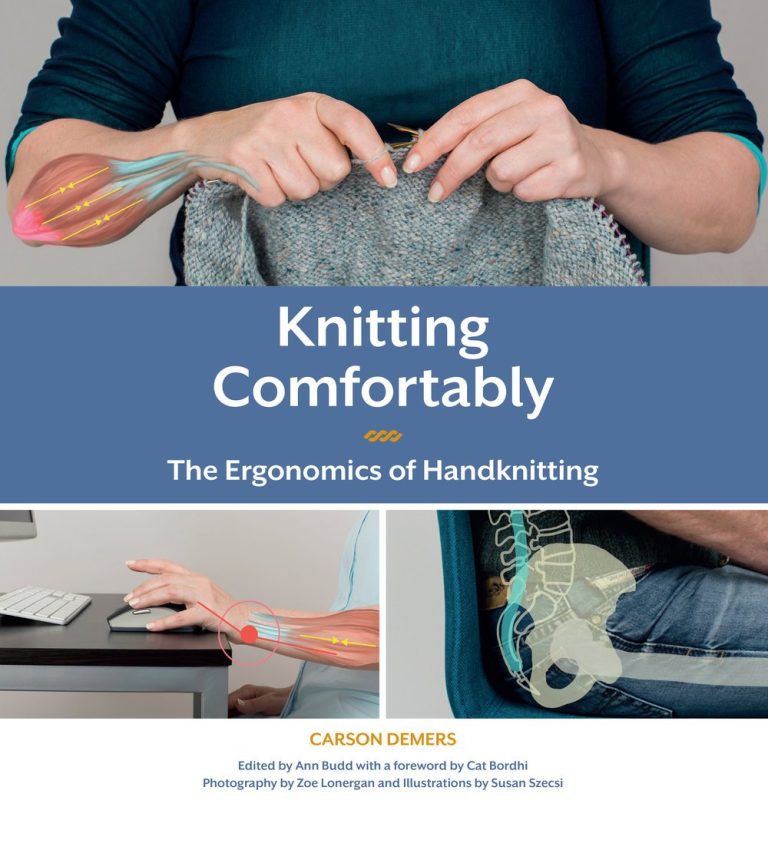
"Knitting Comfortably" update

I’m happy to announce that Knitting Comfortably was just sent off for its sixth reprint! I would have never guessed (although I hoped) that my book would be in the hands of over 18 thousand knitters around the world. I dream that the book will find its way into many more hands because I believe that the information it shares truly is (as said by a reader), “as important as to knitting as the knit and purl stitch.”

I have to tell you, this reprint almost didn’t happen. And in full transparency, I’ve got my fingers crossed that it makes it to shore. My book has always been printed in China. I do it there because they have fantastic color printing, and of course, because it’s less expensive than printing in the States or even Canada.

Prices have gone up over the almost 8-years since the book has been in print, but I’ve never raise the price or changed the wholesale discount rate. There are loads of hidden costs in producing and distributing a book that, unless you’re an author or publisher, you probably don’t know are there. And they’ve all increased.

This printing, however, the threat of increased tariffs will have a huge impact on whether I can actually take receipt of the book. When the book when to reprint the estimate was 20% tariff. Now we’re hearing it could be 125%! Unfortunately, I won’t know if the tariff is imposed until the books arrive in US customs where it will be determined whether or not it’s considered a text or health-related book (no tariff applied) or a knitting book (tariff applied).

So pins and needles for a while.

Now you may ask, as many people have, why not make it an e-book?  That’s a good question.

When I set out to write the book I had a few visions for the book. One was that it would be in LYS and not on big sellers like, well, you know who. I’ve stuck by that! The reason is that we all spend so much time on laptops, tablets, etc. that I didn’t want using the book to contribute to the problems it’s trying to prevent. Now, I understand compromise and financially, this new printing may need to be the last. But for now we’re still going old school.

What's on the needles

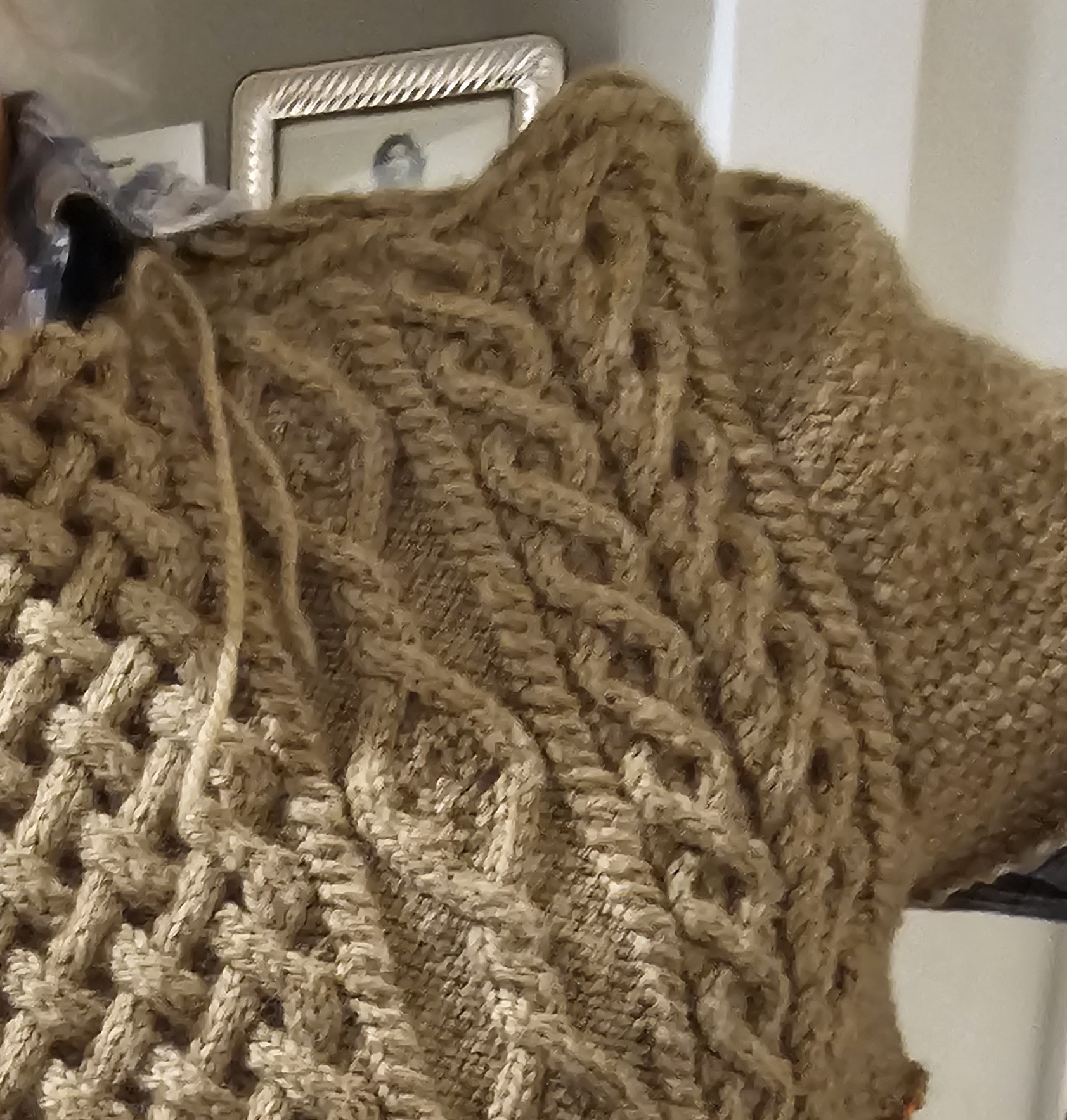
Several months ago I started a friendly knit along with my besty Mary Elizabeth Scott. Our plan was to have besty Aran sweaters. We chose Aran styles because we met ages ago in a series of Aran design classes taught by Janet Szebo (Big Sky Knitting).

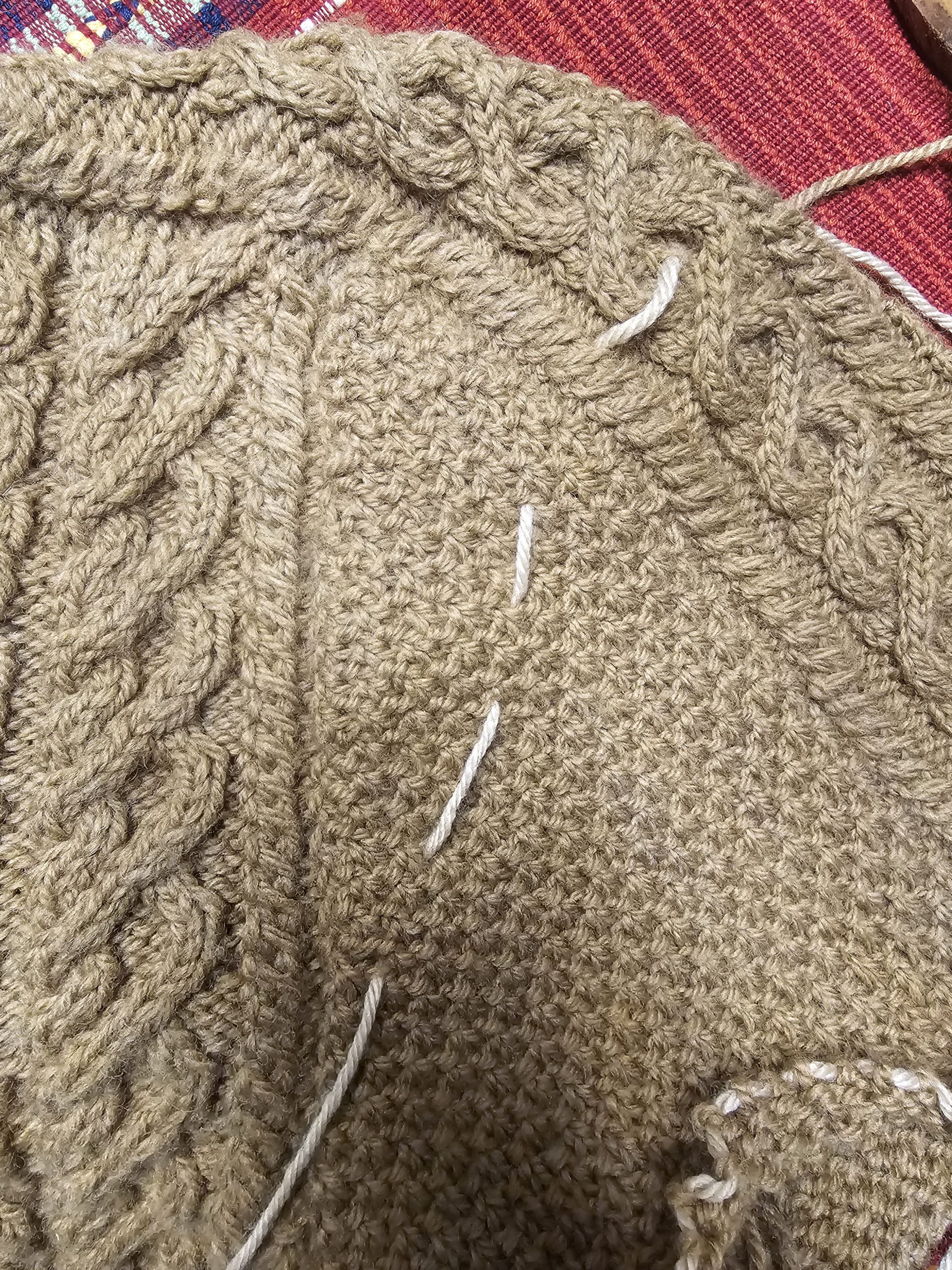
Mary is fiendishly clever, a source of endless envy and frustration by anyone trying to keep up with her. Her sweater was done in no time. Mine, not so much. In all fairness, she had hers mapped out before I even started, and I am a smidge larger than she, but I take full accountability for all the other things that slowed me down. Chiefly, sleeve caps on a set-in saddle shoulder.

This was a fascinating design challenge because the cables themselves really impact the structure or drape of the fabric. There was also  the matter of reingineering cables to be reversed, flipped, etc. to create symmetry in the garment.

Well, I’m in the home stretch now. Most of the sleeve shaping is done and I’m working on the body toward the border which has yet to be designed.

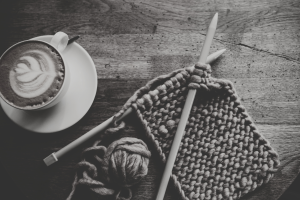
I rarely use a cable needle when I knit cable patterns. It is of course, knitter’s choice, but I love the rhythm that cables provide even when there are risks of dropped stitches, etc. Here’s a couple of tips for making cabling without cable needle easier.

Most importantly, choose a needle with a long taper at the tip. You need that space to manipulate all those stitches. In this case the largest cross is just 3×3, but the stitches get tight with cables and it’s easy to lose them especially if you’re picking up on the backside of your work.

Second tip, if you’re doing a right over left cross (stitches cross to the left) and don’t want to hassle with picking up through the back side of the left side stitches, slip all the stitches involved in the cross to the right and pick up the  stitches that will be crossing left from the front instead. The point of this extra step is that you won’t lose stitches in the back of the work where it’s sometimes tricky to find them.

And finally, spend some time in the “playground” intentionally making mistakes and fixing them, so you’ll have that skill and confidence at hand should something go awry.

What's on the bobbins

I was visiting a friend in Albuquerque last December and couldn’t miss the opportunity to visit  Fiber’s on Fourth. This is the brain child of Cael Chappell and home to The Natural Twist, Ruth Baldwin’s wonderful shop.

Fiber’s on Fourth is a destination not to be missed for any fiber artist. You may know Cael’s from his work with Baskets of Africa. He even has some African baskets for sale there. But you’ll also get to see his own weaving on display. His work is simply incredible.
 
I fell in love with Ruth’s fibers several years ago because they are often luxurious, and always impeccably dyed. I also love her humor in naming her colorways and fiber lines. When I first met her she had a camel blend and it was called Camelot. Each color was a character from the musical. I think I bought every single one of them.
 
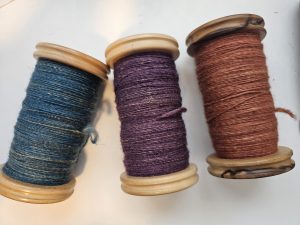
This time it was her Gold Rush series that grabbed me. Merino, mohair and Red Eri silk blended and put up as sliver. Colors like Klondike, Eureka, 49-er made choosing very difficult. In the end I opted for 2 thinking I’d make 2 separate fingering weight yarns. But I quickly realized I want more yardage so I thought I’d ply the 2 colors together. I originally chose Klondike – a lovely red-violet color and, Eureka, a beautiful persimmon hue. My friend kindly went to the shop and discovered these colors were gone, so lets add a third. The final color is 49-er, a turquoise color. Despite their Gold Rush theme, these colors make me think of the American Southwest. This will now become a big round 3-ply and I’ll knit something decadent with it and wear it next time I visit Ruth and Cael, and my friend.
 
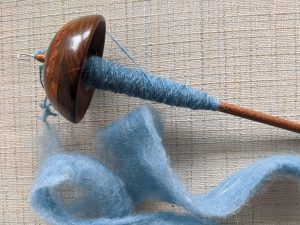
My spinning tip – When you’re spinning a blend be sure you “dissect” a bit of the fiber so you know the lengths of each component. In this instance, how long are the mohair fibers vs. the merino vs. the silk. It turns out that there are a few lengths of silk in the blend. Why is this important? Because if you want your singles to be a consistent diameter you need to stay aware of those short bits. You need to draft past them or you’ll get a thin spot in your singles, especially where there are more fibers of little to no crimp. These fibers hoard the twist and get skinny fast!
 
I promise I’ll have these plied for the next update, but it’s been busy around here and I’m behind.

And now, the Dash Report

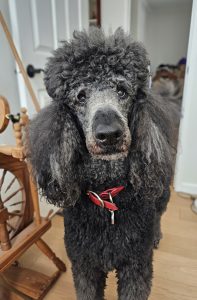
It’s hard to believe, but we celebrated our 4th Welcome Home anniversary recently. Dash is very glad that the backyard has dried out sufficiently to play ball without getting muddy. So am I. And so are my white carpets.